Tuesday, March 23, 2010

Phaeton's Crash and Another Love Story

I really like how Mary Zimmerman's version is so much more interesting than the other old original texts. Although its all the same stories, her version (maybe because it has modern language and attitudes in it) is much more absorbing. In this reading, Phaeton dies but Eros & Psyche live happily ever after.

Something that, in my opinion, gives Phaeton's character a fun story in Mary Zimmerman's version is his attitude. At some points he sounds spoiled, "Now there's only one thing I want, I mean its obvious, right? I say 'Give me the keys to your car'" (66)while at others he gets bullied, "So I tell him my father's the sun and he says, 'Tell me another' and I say, 'He's the sun, he's Phoebus Apollo' And he just basically trampled me, just basically beat the shit out of me. Like I was lying" (63). These descriptions turn this story from a tragedy into a comedic scene where Phaeton is just a normal teenager that like any other teenager likes to try new things. I actually laughed when I read Phaeton's lines because nowadays parents worry about other things like alcohol or drugs, not driving over the sun. I also like how the Gods are not perfect. Unlike the Christian/Catholic God, the Greek Gods actually mess up sometimes and Mary Zimmerman makes these mess-ups look funny and ironic.


Eros & Psyche's story is my favorite until now. This is another love story but I think it's very different from the others because Psyche actually works hard to stay with Eros. I think that it was very surprising when Zeus "gives Psyche a special potion and she becomes immortal. Then he declares that their marriage will last forever"(75) because I would've imagined any of the other gods helping Psyche and Eros, not Zeus. I also like how love is described in this story, "It's just inevitable. The soul wanders in the dark, until it finds love. And so, wherever our love goes, there we find our soul." (76) What this is saying is that love makes us complete and leads you out of the dark. Metamorphoses talks about many kinds of love throughout the stories, Myrrha's unhealthy love for her father, Ceyx's and Alcyone's star-crossed love, Vertumnus's neglectful love that eventually loves him back, Eurydice's and Orpheus's love that wasn't meant to be, Eryschiton's love for food, and Midas's love for gold, are all examples of different kinds of love. No matter what kind of love it is, according to Metamorphoses it completes you and it is a part of you, like the soul.


"Love actually is everywhere" - Love Actually (All kinds and types of love, similar to Metamorphoses in that sense)

Phaeton's Couplet

He rode over the sun, set the world aflame,
killed himself, and foolishness took the blame.

Monday, March 22, 2010

More Love Stories

As I've been reading Metamorphoses, love has been present in most of the readings. The ones this post is about are no exception. Being a teen-age girl, I suppose I fit the cliche since I enjoy anything that has to with love. The story of Pomona and Vertumnus is the perfect example of a love story (also referred to as chick-flick nowadays). On the contrary, the story of Myrrha and Cinyras, is more of a scandal. Although these stories have very little to do with each other at first, (one has a sad end, the other a happy one) they actually have much in common. To begin, both Myrrha and Vertumnus try to hide their identities to get what they want, and second, they end up revealing themselves without being able to stop it. Myrrha does her best to prevent her father from knowing the truth, but eventually, he finds out and there's nothing more she can do. The girl begs the Gods, "Oh Gods, I pray you, change me; make me something else; transform me entirely; let me step out of my own heart".(60) This part also suggests more evidence to the title, Metamorphoses. Many characters throughout the stories have been changed into trees or even gold, and in the case of Myrrha, "She stepped into a shimmering stream and began to dissolve: Her body melted." (61)

A big difference that I found between Pomona & Vertumnus and Myrrha & Cinyras, was the God's inetervention in the character's development. In previous stories, like the one of Alcyone & Ceyx, everything began to go wrong when the Gods intervened in the lives of these characters. If it wasn't for Poseidon, Ceyx would've never had difficulty at sea, and if it wasn't for Aphrodite, Myrrha would've never fallen in love with her father. So far, the Gods have brought nothing but trouble and it is because of them that the stories have turned into tragedies.

However, this changes when Vertumnus courts Pomona without the help or intervention from any of the other Gods, Vertumunus manages to win Pomona, "When at last the god revealed himself just as he was, much to his surprise, he had no need of words. Little Pomona was happy with what she saw, unadorned and undisguised. Soon enough, the vine was clinging to the tree." (62) This is my favorite part in Metamorphoses up to now. It's so sweet how in the end, Vertumnus doesn't need anything but himself to make Pomona happy. Sometimes, being yourself is all it takes to get what you want. I really liked how this story ended and it's good to have a happy ending once in a while. Returning to what I mentioned previously about the intervention of the Gods, Vertumnus is a God, but in the lack of interruption on the God's side granted Vertumnus what he longed for, Pomona. The Gods, in my opinion, are supposed to bring good fortune and wish only the best for their followers, but in this case they have proved me wrong, good fortune is best attained when the Gods don't interfere at all.


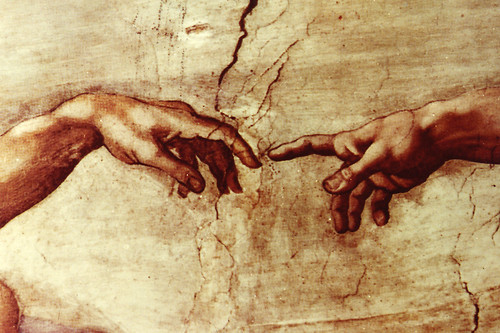
This picture has absolutely nothing to do with either Myrrha & Cinyras or Pomona & Vertumnus, but it is one of my favorite paintings and it was on the list of images we could use.

Thursday, March 18, 2010

A Man with a Hungry Nature

There were many things that stood out as I read this story. First, nature is representing the gods once again (just like Gilgamesh and the Cedar Forest) and the gods continue to punish people. When Ceres decides to show Eryschithon her power and let him know that she isn't someone you can fool around with, she decides to punish him with hunger. Ceres, being a goddess, probably predicted how the story would end and chose this punishment to enjoy watching as Eryschithon consumed the last bits of his body. I think that this is actually a very funny punishment since it must be very entertaining to watch a person who thought of himself as very high end up so low.

Returning to nature playing a big role here, it is the destruction of a tree that causes all the trouble with Ceres. Man has tried to conquer nature over centuries and texts like Gilgamesh or the Bible prove this. Ceres obviously loved her tree and went to extremes to make sure that he who was responsible for these actions payed for them. I've seen a pattern in texts were man tries to conquer nature in which man always ends up defeated. I don't know if it's something human kind has known all along -that man will always lose against nature- but even today man keeps trying to push nature's fragile balance to save themselves from the difficult situation in which they now find themselves in.

I found that nature is very important for this part of the story since its what causes Eryschithon wealth and sanity to crumble. Apart from nature, I found that another very important aspect to the development of the story is the punishment. As I mentioned before, Ceres probably already knew what would happen and expected it to happen. The gods have a huge influence on the course of people's lives and people are incapable of avoiding this. The helplessness towards the gods is something that all humans have seen themselves in at some point. Even the Catholic God today has a big influence on the way that people live every day.

Wednesday, March 17, 2010

A Mytholigical Love

I enjoyed reading this story very much. Love is a part of life that humans face each day. Love has many sides to it and it means something different to everyone, I think it was very interesting how these two lovers interact and express their affection. The way that Alcyone tries to keep Ceyx from leaving, and the way that Ceyx calls her name just before he dies is a very common thing to do between lovers in a story. I just finished reading a book that was written for teenage girls and all it talks about is first love, drama, more drama and eventually they end up together. As I read this part in Metamorphoses, I kept thinking about the book I had just finished. It reminded me of how the lovers in the book I had just read kept thinking about the other during hard times and how similar this was to Alcyone and Ceyx, who acted likewise.

The Greek gods have been very influential throughout history and their similarity to human behavior has been subject of much attention from people who like to study them. I still don't know what it about Greek mythology that makes it so important but I think that after reading Metamorphoses I will have a better idea of what makes them so relevant in our society. I have seen though, that the gods play a big role in the character's development as the story goes. Also, the god's actions and feelings are what determine a person's fate. I think that this reasoning is a little absurd since some of the gods are selfish and do as they please without thinking about the person's well being. I've concluded that this is probably the reason why the Greek gods are so influential, because they have very human-like behaviors and are almost equal to humans, only they have powers.

Talking about the Greek mythology, Ishmael came to mind. I remember there was one point in which Ishmael tells his pupil how everything is a myth. I relate to Ishmael in this sense because I do think everything is myth unless proven otherwise. So, what might seem as silly stories to me, it was actually what people believed in centuries ago. What this means, and what I make of it is that basically, what I believe in now, is just another myth. Although my conclusion may be wrong, I thought it was very cool how Ishmael relates to Greek mythology in that sense.

Sunday, March 14, 2010

The Creation in Metamorphoses


Listening to this audio version was little challenging since it's in both English and Latin it was hard to keep up with what Ovid was saying. What I did get though, I found very interesting. The previous texts we have discussed in class (Gilgamesh and Bhagvad Gita) are both ancient and have to do with deities at some point or another but rarely, if ever refer to creation. It surprised me that they actually say that "He first molded the earth into the form of a mighty ball" because its the first time that I see someone describe the Earth as round other than Christopher Columbus. I saw the play at school last semester so I have an idea of what Metamorphoses is about so I guess that helped me have a better image of what was going on. So far, I liked the descriptions and I think that as the story develops, it is just going to get more compelling.

I liked the effect that music gives to it because it makes it mysterious and intriguing but I also think it's a little corny.

It took me some minutes to realize that Ovid was not the guy speaking but the author of Metamorphoses. Oops.

Tuesday, March 9, 2010

The End of Bhagavad-Gita


With the end of Bhagavad-Gita, I concluded that this text depicts humanity and some of them even concern society today. I think that the teachings reflect the many ways in which humans react in situations that they don't know how to handle so they seek for advice. The lessons Krishna gives to Arjuna are very important because with these it is that Arjuna decides who he wants to be. Although Krishna does influence Arjuna's final decision, I thought it was very valuable that he gave Arjuna the chance to decide for himself. The importance of the teachings is not Arjuna's final decision, instead, all that Arjuna learned that will help him take the right paths in the future.

I really liked the way that Krishna explained his teachings to Arjuna. This text which is also similar to the bible, in the sense that it's a set of instructions and it has to do with deities, was actually very compelling. I think that what makes it so, is the fact that the teachings are not condemning you or punishing you, they are just advising you to make the right decisions and take some time to think your actions.

I agree with most of the values that Krishna tells Arjuna about but there were others that I just thought were absurd. Well, I actually really liked all the concepts of devotion, sacrifice, knowledge, etc. but what I didn't like was the way that Krishna told Arjuna to perform these for example, I'm not very religious and I couldn't picture myself being as devoted to a god. I think that being so devoted wouldn't let me see or understand other opinions and I would a have a very biased perception on the world. Instead, I would devote myself to a cause or a belief. Again, the concepts were very accurate and I think that used in another context, they would actually apply in society today.

I suppose that these teachings were especially important to me because I relate to them in some ways. It surprised me when Krishna refers to ignorance as man's ruin because I share the same opinion. This was probably the part I found the most interesting since (I'm guessing) this text is very very old and they were already thinking about ignorance. Today, the modern world has found that a possible solution to ignorance is education, yet a big percentage of this planet's population does not receive proper education if any at all. Education is a big issue nowadays and I was amazed at the fact that years ago, people were already worried about ignorance.

Sunday, March 7, 2010

Krishna's Eye


In this picture/drawing I decided to put an eye(Krishna) watching how people pass and live their lives continuing the cycle. I also put the two outlines of the bodies. They are both empty so they symbolize that a body is just a body after death and that the spirit and soul return to take a new body. Rebirth and reincarnation were some of the things that interested me the most so this is my interpretation of the way that Krishna sees it.

The Fulfillment of Purpose and Man

Everything written on the Bhagavad Gita has something to do with man to a certain degree. Just as the Bible or the Koran, this text is made up of disguised instructions for mankind on how to live their lives and make the most out of them while making sure that both individuals and society receive some kind of benefit. These teachings focus on the nature of man and how to know the field. Teaching fifteen, which was also the one that impacted me the most, talked about the true spirit of man. The last stanza talked about fulfilling a purpose and in my own perception, Krishna’s equivalence of fulfilling a purpose is when a man discovers him and devotes himself to him. Although I disagree with this “fulfillment of a purpose”, I do believe that we are all here to do something. Fulfilling a purpose is something very important to me and I believe that this is why we are all here. “Arjuna, thus I have taught this most secret tradition; realizing it, one has understanding and his purpose is fulfilled.”(126)

After completing most of this text, I’ve concluded that all of the teachings are connected to each other. It took me some time to realize this, but even Krishna himself often refers to his previous lessons to give Arjuna a better picture of what he is explaining now. This connection reminded me of how Krishna explained the cycles in life and indeed, values are part of this cycle as well. If anyone wants to be successful, they should follow the teachings. According to Krishna, no man is complete without knowledge, discipline, action, etc. and this is what links the teachings, they all make man whole.

I, Lord Krishna

These teachings were very different from the previous ones. For the first time, Krishna describes himself. He tells Arjuna that everything, animate and inanimate are a part of him. I concluded that Krishna’s descriptions basically say that everything depends on him, he is the creator and the one that sustains the world. This seemed to me a little similar to the Christian God. Krishna also continues to describe the way he rules and the way he is worshipped. “I am impartial to all creatures, and no one is hateful or dear to me; but men devoted to me are in me, and I am within them.” (89)

Something else that I consider is very important is how much focus these teachings had on Krishna. Starting from the point in which Krishna stops giving Arjuna advice to the point in which he begins to tell Arjuna to devote himself to him.
“If they rely on me, Arjuna, women, commoners, men of low rank, even men born in the wombof evil, reach the highest way.
How easy it is then for holy priests and devoted royal sages--- in this transient world of sorrow, devote yourself to me!
Keep me in your mind and devotion, sacrifice to me, bow to me, discipline your self toward me, and you will reach me!”
Also, Krishna gives me the impression that before, he was just telling Arjuna the great things that come with following his advice. However, Krishna never really tells Arjuna that to achieve this, he must worship him. I think this is interesting because it is a strategy that people today use to sell, to recruit, to get approved or to simply get what they want.

I found that Krishna never talks about a heaven or a hell, instead he refers to rebirth. “Reaching me, men of great spirit do not undergo rebirth, the ephemeral realm of suffering; they attain absolute perfection.” (81) According to Krishna, those men who have already reached him don’t undergo rebirth and in some way, this stage could reflect heaven, while rebirth reflects hell. “Arjuna, I shall tell you precisely the time when men of discipline who have died suffer rebirth or escape it.”(82)


The following video contains one of the most famous songs ever composed and performed by George Harrison. I’ve grown up listening to this song but I had never really understood it. Finally, when I was reading about Krishna in the Bhagavad Gita, it all made sense. My sweet Lord is a song about Harrison’s personal revelation and how much he worships the Hare Krishna.

Self-discipline, Actions and Knowledge


While reading these teachings, I realized how much I agreed with Krishna’s definition of ignorance. One of the things he says that really stood out was “An ignorant man is lost, faithless, and filled with self-doubt; a soul that harbors doubt has no joy, not in this world or the next.” (56) I consider this a very true statement since even today, ignorance is a very big deal in society and it defines the way that people perceive each other. Everyone has a level of ignorance and another one of knowledge. When an ignorant man is “lost” it’s basically saying that the lack of knowledge has caused this person to lose an identity, without and identity, everything becomes doubtful and there is a constant necessity for justification. I suppose that Krishna saw ignorance as man’s ruin. Ignorance being the complete opposite of knowledge, “Faithful, intent, his senses subdued, he gains knowledge; gaining knowledge, he soon finds perfect peace.”(56) Knowledge can also be associated not only with an identity, but also with self-discipline. Krishna discusses self-discipline and explains how this allows anyone to perform their actions with understanding and order, therefore, performing them wisely. “No wise man disturbs the understanding of ignorant men attached to action: he should inspire them, performing all actions with discipline.” (46) This also gives grounds for the fact that those more knowledgeable are more prone to inspiring those with less knowledge, and set an example or at least conduct some kind of leadership.

During Krishna’s explanation of the difference between discipline and the renunciation of actions, he often refers to joy as an attribute to knowledgeable men. Krishna is explaining to some degree, the ways of the world to Arjuna who questions him about values and that having knowledge implies. It seems that Krishna is giving instructions to Arjuna on how to make the most of his life and how to help others make the most out of theirs’. Krishna constantly coaxes Arjuna indirectly to follow his advice by telling him the great joy he will achieve by doing so, “A man able to endure the force of desire and anger before giving up his body is disciplined and joyful.”(62)

Monday, March 1, 2010

The Second Teaching: Courage, Discipline and Reincarnation


As I continued reading Baghavad Gita, I noticed how similar these teachings are to some of the Buddhist principles, such as reincarnation, serenity and peace with one’s self. I don’t practice Buddhism and I’m not an expert, but I do know some things about Buddhism. Also, after looking at some images to include in this post, I concluded that the Baghavad Gita must have some type of relation with Buddhist India.

The first part that really stood out was how important reincarnation is. The Krishna uses reincarnation as a way to persuade Arjuna not be a coward. I also remembered about what we have studied in class about rhetoric, and I inferred that this was actually a very effective way of convincing people. The Krishna talks about reincarnation and explains it as simply as changing clothes, "As a man discards worn-out clothes to put on new and different ones, so the embodied self discards its worn-out bodies to take on other new ones."

In addition, I considered how death is taken in the previous reading, The Epic of Gilgamesh. In both these texts, death has a very different meaning. Gilgamesh wished to live eternally, but Krishna talks about a varying view on dying "If you are killed, you win heaven; if you triumph, you enjoy the earth; therefore, Arjuna, stand up and resolve to fight the battle!" (37)
Also, Gilgamesh grieves for his lost friend Enkidu, yet Arjuna is encouraged not to grieve, for "Death is certain for anyone born, and birth is certain for the dead; since the cycle is inevitable, you have no cause to grieve!" (35)

I found it very interesting that discipline is shown as a way find serenity and peace with oneself. Also, discipline is shown as a balance between actions, success and failure, "Perform actions, firm in discipline, relinquishing attachment; be impartial to failure and success- this equanimity is called discipline." (38) As I mentioned in the previous post, this is also a value that applies to society today. Discipline, perseverance and determination are usually the things that get you places. Finally, there was a sentence that drew my attention because I thought it was very accurate, and again, I think it applies to society even more today then all those years ago. "Brooding about sensuous objects makes attachment to them grow; from attachment desire arises, from desire anger is born." (40) I really empathize with the explanation for how anger is born. When I read this part, I thought about how materialistic the world is today and how individualistic it has become, creating a hating and unjust society.

“It is a man’s own mind, not his enemy or foe, that lures him into evil ways.”
-Buddha

The First Teaching: Happiness and Family Duty


This first teaching of the Baghavad Gita was very interesting. The war that was going on between the family members reminded me of the many events in history that have been determined by family decisions. I studied the Maasai tribe in Kenya and Tanzania last semester and there was a story that automatically came to mind.

When the Europeans began to settle in Maasailand during the 1800’s, one of their strategies in order to succeed was to divide the enemy. The ruler had two sons that both wanted to inherit the throne. The colonists saw this as an opportunity and decided to help one of the brothers with weapons to fight the other one in exchange for some land. The weapons gave that brother a huge advantage and eventually, he won. Ever since, the Maasai have lost their land and have been left with very little territory to raise their cattle.

In Baghavad Gita, one of the main focuses was about family values. I thought about how much damage one’s greed and egoism can affect others and even oneself. The Maasai story reminded me of how these things can bring destruction and pain in the long run and how both family duty and brotherhood are of so much value to a community.This was obviously one of the reasons why the Krishna did not want the war between kin to happen. One of the parts in this teaching that I thought gave a good example of the points I have stated above is the following:

"Krishna, we have heard that a place in hell is reserved for men who undermine family
duties.
I lament the great sin we commit when our greed for kingship and pleasures drives us
to kill our kinsmen" (29)

Another part that stood out was when the Krishna talks about honor.
"Honor forbids us to kill our cousins, Dhritarashtra's sons; how ca we know happiness
if we kill our own kinsmen?" (28)


I agree with this part because after thinking about it I realized how hard it must be to live knowing that someone in your family has died because of you. However, I thought that this is one of the most important values that still apply in society today. Many workaholics leave their family aside and take them for granted without realizing that their work is taking up much of their happiness. The issue of happiness is very vital for your mental sanity and knowing you killed somebody isn’t really on the path towards happiness.

"Happiness comes when your work and words are of benefit to yourself and others."
-Buddha