This time I chose John. The last time I read the Bible, I read Luke's gospel and there was a John the Baptist in it. I wondered if the John who wrote the gospel was the same as the one Luke referred to. This is what I found.
To my surprise, I was actually right this time. John is indeed Jesus' cousin, John the baptist. I suppose that this is a rather irrelevant conclusion but what I find so important in it is the fact that Luke actually mentions John. Although John spares parts with angels in them, unlike Luke, he does acknowledge the fact that there is a God. This also makes me wonder if he knew beforehand, since he was older than Jesus, if Jesus would be the Christ. This is something that doesn't really have an easy answer but at least, up to now,he does say " I saw, and bare record that this is the Son of God." (John 1:34)
First of all, John starts his gospel with Jesus' baptism as oppose to Luke who begins his gospel with the first Christmas. This first difference is a bit crucial because it's basically saying that Jesus' story begins with his baptism, once he is the "son of God" officially while Luke thinks that Jesus' story is worth telling from the very beginning. This also implies that Jesus only comes into John's life once he gets baptized by him.
I also noticed that the miracles that John talks about are more "materialistic" than those that Luke mentions. Luke tells us about how Jesus came into every village to "heal" the sick but John focuses on how Jesus turned water into wine at a wedding. This might also seem like an irrelevant observation but in a way, its these things that describe what Luke or John might actually be.
Its interesting to see Jesus' story being told from different perspectives rather than just one. I think that the more participants in a story, the better the story will be. And why is this you may be asking yourselves right now? Well, this is what I believe: any story becomes plain and boring when this old guy is telling it (my image of Luke) but when there is more than on narrator, the reader has the opportunity to agree, disagree and later, even take sides towards one version or the other.
Tuesday, May 25, 2010

Sunday, May 23, 2010
Luke Repeats Jesus' Final Words
As Jesus keeps speaking I've found many similarities between him, Lao Zu, Krishna and Confucius. All of these men can be called teachers. They all had the same purpose in the sense that they all taught somebody at some point. Each had their own particular way of relating to others and they all had very different conceptions of the world. I believe that the real issue here is not who's wrong and who's right but how each of them did what they did. What is specially particular about Jesus is that although he did have some trouble spreading his word, he did it by traveling and getting to meet as many people as he could. As oppose to the other men who instead, shared what they thought without necessarily putting it into practice. This is what I like about Jesus. Out of all the characters we've seen in the Bible so far, Jesus is probably the one I've liked the most. He is practical and I relate to some things he does although I disagree with most of them.
For example, when he "heals" everybody its as if he can do anything he wants. Don't get me wrong, he should be able to do it as freely as he wants. What I don't like about it though is the way he does it. He keeps saying that "faith" is what "heals" people and maybe it is, but it all depends on everyone's personal perception on faith. To me, faith is being positive and having trust in what is coming next, but what about those who think differently from me? Some may think that faith is relying on what has happened before and expecting only good things to come, when they don't its like the world is falling apart. Others might think that faith has more to do with what God expects of you than doing what you actually think is right for you. As I have said previously, no one can rely on just black or white, people should expect different shades of gray. This is the basis of my disagreement with Jesus, yet I do love the fact that he was there for the people and tried to heal as many as he could. This reminds me of Mother Theresa, I can see where she got her inspiration.
Most of what Luke keeps talking about are Jesus' miracles and all the things he did for the people. In chapter 21, something similar comes up, only this time I think that what Luke is telling us, is about the first mass, "37And in the day time he was teaching in the temple; and at night he went out, and abode in the mount that is called the mount of Olives. 38 And all the people came early in the morning to him in the temple, for to hear him." (Luke 21) This is definitely more interesting because people came to listen to what Jesus had to say. I find it very interesting how the story continues because it's like Jesus became a celebrity.
The last supper is probably the most emotional the Bible or anything we've read has been up to now. "19 And he took bread, and gave thanks, and brake it,and gave unto them, saying, This is my body which is given for you: this do in remembrance of me. 20 Likewise also the cup after supper, saying, This cup is the new testament in my blood, which is shed for you." (Luke 22) Anyone who says things like these must have one out of two of these: either a very high ego or an immense love for all those around. I'm betting Jesus is more like the second option. I've seen interpretations of the last supper by artists such as Da Vinci and they all seem very melancholic. However, what I felt while I was reading this was suspense rather than sadness or pity. I couldn't wait to see what all the other apostles would say once they found out who the actual traitor was. And they began to enquire among themselves, which of them it was that should do this thing." (Luke 22:23)
If it weren't for the priests and the captains offering Judas money, Judas wouldn't have any problems with Jesus, but I think that betraying Jesus or not, Judas would be the same anyways, and at some point this would become evident. It is said the Satan "entered" Judas, what I really think is that Satan wasn't inside of Judas, he was inside of the captains who wanted to kill Jesus. If Satan, was indeed inside the captains, why didn't God stop them? Why didn't God protect Jesus by making sure Judas wasn't a traitor? I've asked myself these questions before and it seems to me that I'm finally getting answers.
"And his sweat was as it were great drops of blood falling down to the ground."(Luke 44:22)This caught my attention because its a simile. The first simile I've seen so far. Maybe I'm not being as observant but I thought that similes were something more modern, not something used in the Bible. I guess I was wrong. This is however, a powerful simile. Not everyone gets to feel drops of sweat as if they were "drops of blood". It gives you the idea of what it must be like to be living such an uncertainty and being under such a terrible situation. This is one of the things I admire about Jesus, if I were him and I was going through what he was, I could have never sat down to pray. This to me seems almost as if giving up and accepting one's fate. However, there wasn't much he could do anyways so this seems to me as one of the saddest ways to say good-bye.
When it becomes Peter's turn to say good-bye it felt like such a sad farewell for the both of them. Peter, who was loyal and obviously loved Jesus had to "deny him thrice". "58 And after a little while another saw him, and said, Thou art also of them. And Peter said, Man, I am not. 59 And about the space of one hour after another confidently affirmed, saying, Of a truth this fellowalso was with him: for he is a Galilaean. 60 And Peter said, Man, I know not what thou sayest. And immediately, while he yet spake, the cock crew. 61 And the Lord turned, and looked upon Peter. And Peter remembered the word of the Lord, how he had said unto him, Before the cock crow, thou shalt deny me thrice. 62 And Peter went out, and wept bitterly" (Luke 22) Being a friend and being part of a family I understand what Peter is going through and it just makes me sad. The entire scene is so depressed and sorrowful that it makes me miss God's interventions. God always steps in at the right moments, just before Abraham kills Isaac, and just before Job can;t take it any longer. What happened to God today? I can't believe the bonds between these two. It must have been just as hard for Jesus to say those words to Peter as it was for Peter to follow them. I recently watched a movie in which a similar idea is debated. In My Sister's Keeper, a girl with leukemia asks her younger sister who is about to give her a kidney not to do it because she wants to die. In the end, the one with cancer does die, but she had no other option. Although the little sister had to make this hard decision to let her sister die, she knew it was what would make her happy. In this case, Jesus has no other option, and Peter has nothing left to do but follow what Jesus asked him to.
At last, Jesus is crucifixed. I couldn't believe the ridiculousness of the trial."And they began to accuse him, saying, We found this fellow perverting the nation, and forbidding to give tribute to Caesar, saying that he himself is Christ a King." (Luke 2:23) Just his accusations are so foolish and ignorant. I was actually proud of Jesus when he says, "Father, forgive them; for they know not what they do." (Luke 34:23) This was what ratified my admiration for Jesus. He seems like such a fragile person in front of the guards yet he is strong and says this like it was all he wanted, for God to forgive them. It seems a bit sarcastic but the truth is, Jesus meant it and that is what makes it such a powerful statement.
I never thought I'd like Jesus as much as I do now and I didn't think I'd have so much fun reading the Bible as I did reading Luke's Gospel. It was never a part of my conception of the Bible that it would be so emotional and that it would be so suspenseful. Although the suspense lasts only a couple of lines, its enough to make your heart race. I almost cried with the very vivid descriptions of Jesus' slow death and Peter's farewell. To be honest, not once did I think that the Bible would produce such intense moments yet I think that the New Testament is much more striking than the Old Testament because (at least me) you get to see the character's development more deeply and its less of God trying to impose himself. I can say that this part exceeded my expectations of what the Bible would be, and I ended up liking Jesus, so I suppose I did get something out of it after all.
For example, when he "heals" everybody its as if he can do anything he wants. Don't get me wrong, he should be able to do it as freely as he wants. What I don't like about it though is the way he does it. He keeps saying that "faith" is what "heals" people and maybe it is, but it all depends on everyone's personal perception on faith. To me, faith is being positive and having trust in what is coming next, but what about those who think differently from me? Some may think that faith is relying on what has happened before and expecting only good things to come, when they don't its like the world is falling apart. Others might think that faith has more to do with what God expects of you than doing what you actually think is right for you. As I have said previously, no one can rely on just black or white, people should expect different shades of gray. This is the basis of my disagreement with Jesus, yet I do love the fact that he was there for the people and tried to heal as many as he could. This reminds me of Mother Theresa, I can see where she got her inspiration.
Most of what Luke keeps talking about are Jesus' miracles and all the things he did for the people. In chapter 21, something similar comes up, only this time I think that what Luke is telling us, is about the first mass, "37And in the day time he was teaching in the temple; and at night he went out, and abode in the mount that is called the mount of Olives. 38 And all the people came early in the morning to him in the temple, for to hear him." (Luke 21) This is definitely more interesting because people came to listen to what Jesus had to say. I find it very interesting how the story continues because it's like Jesus became a celebrity.
The last supper is probably the most emotional the Bible or anything we've read has been up to now. "19 And he took bread, and gave thanks, and brake it,and gave unto them, saying, This is my body which is given for you: this do in remembrance of me. 20 Likewise also the cup after supper, saying, This cup is the new testament in my blood, which is shed for you." (Luke 22) Anyone who says things like these must have one out of two of these: either a very high ego or an immense love for all those around. I'm betting Jesus is more like the second option. I've seen interpretations of the last supper by artists such as Da Vinci and they all seem very melancholic. However, what I felt while I was reading this was suspense rather than sadness or pity. I couldn't wait to see what all the other apostles would say once they found out who the actual traitor was. And they began to enquire among themselves, which of them it was that should do this thing." (Luke 22:23)
If it weren't for the priests and the captains offering Judas money, Judas wouldn't have any problems with Jesus, but I think that betraying Jesus or not, Judas would be the same anyways, and at some point this would become evident. It is said the Satan "entered" Judas, what I really think is that Satan wasn't inside of Judas, he was inside of the captains who wanted to kill Jesus. If Satan, was indeed inside the captains, why didn't God stop them? Why didn't God protect Jesus by making sure Judas wasn't a traitor? I've asked myself these questions before and it seems to me that I'm finally getting answers.
"And his sweat was as it were great drops of blood falling down to the ground."(Luke 44:22)This caught my attention because its a simile. The first simile I've seen so far. Maybe I'm not being as observant but I thought that similes were something more modern, not something used in the Bible. I guess I was wrong. This is however, a powerful simile. Not everyone gets to feel drops of sweat as if they were "drops of blood". It gives you the idea of what it must be like to be living such an uncertainty and being under such a terrible situation. This is one of the things I admire about Jesus, if I were him and I was going through what he was, I could have never sat down to pray. This to me seems almost as if giving up and accepting one's fate. However, there wasn't much he could do anyways so this seems to me as one of the saddest ways to say good-bye.
When it becomes Peter's turn to say good-bye it felt like such a sad farewell for the both of them. Peter, who was loyal and obviously loved Jesus had to "deny him thrice". "58 And after a little while another saw him, and said, Thou art also of them. And Peter said, Man, I am not. 59 And about the space of one hour after another confidently affirmed, saying, Of a truth this fellowalso was with him: for he is a Galilaean. 60 And Peter said, Man, I know not what thou sayest. And immediately, while he yet spake, the cock crew. 61 And the Lord turned, and looked upon Peter. And Peter remembered the word of the Lord, how he had said unto him, Before the cock crow, thou shalt deny me thrice. 62 And Peter went out, and wept bitterly" (Luke 22) Being a friend and being part of a family I understand what Peter is going through and it just makes me sad. The entire scene is so depressed and sorrowful that it makes me miss God's interventions. God always steps in at the right moments, just before Abraham kills Isaac, and just before Job can;t take it any longer. What happened to God today? I can't believe the bonds between these two. It must have been just as hard for Jesus to say those words to Peter as it was for Peter to follow them. I recently watched a movie in which a similar idea is debated. In My Sister's Keeper, a girl with leukemia asks her younger sister who is about to give her a kidney not to do it because she wants to die. In the end, the one with cancer does die, but she had no other option. Although the little sister had to make this hard decision to let her sister die, she knew it was what would make her happy. In this case, Jesus has no other option, and Peter has nothing left to do but follow what Jesus asked him to.
At last, Jesus is crucifixed. I couldn't believe the ridiculousness of the trial."And they began to accuse him, saying, We found this fellow perverting the nation, and forbidding to give tribute to Caesar, saying that he himself is Christ a King." (Luke 2:23) Just his accusations are so foolish and ignorant. I was actually proud of Jesus when he says, "Father, forgive them; for they know not what they do." (Luke 34:23) This was what ratified my admiration for Jesus. He seems like such a fragile person in front of the guards yet he is strong and says this like it was all he wanted, for God to forgive them. It seems a bit sarcastic but the truth is, Jesus meant it and that is what makes it such a powerful statement.
I never thought I'd like Jesus as much as I do now and I didn't think I'd have so much fun reading the Bible as I did reading Luke's Gospel. It was never a part of my conception of the Bible that it would be so emotional and that it would be so suspenseful. Although the suspense lasts only a couple of lines, its enough to make your heart race. I almost cried with the very vivid descriptions of Jesus' slow death and Peter's farewell. To be honest, not once did I think that the Bible would produce such intense moments yet I think that the New Testament is much more striking than the Old Testament because (at least me) you get to see the character's development more deeply and its less of God trying to impose himself. I can say that this part exceeded my expectations of what the Bible would be, and I ended up liking Jesus, so I suppose I did get something out of it after all.
More About Jesus and God, Now With A Bit of Tao
As I continued to read Luke's gospel I found that not everything in it is the way I was expecting it. One of the things like this is the "apostle" part. I had imagined that the twelve "apostles" had all just been like childhood friends of Jesus or men he had met while he was doing his miracles and thus, the friendship. I was very surprised to know that this wasn't the case. Actually, Jesus "chose" who he wanted as "apostles". "And when it was day, he called unto him his disciples: and of them he chose twelve, whom also he named apostles;" (Luke 6:13) I think that this is rather sad because maybe Jesus chose his most loyal disciples or those he felt identified with. What I find sad about this is what about the other disciples? Weren't they important too? I suppose I'm over-analyzing the situation, but my point is, if he was the "son of God" how could he not know that "And Judas the brother of James, and Judas Iscariot, which also was the traitor" was among those he chose? This are the sort of things that I find a bit weird about the Bible. If God loved Jesus as much as he said he did, why would he let the "traitor" be among Jesus' apostles? Then again, if it hadn't been Judas, it could have also been any other guy overwhelmed with the thought of wealth that losing a friendship would seem insignificant.
It's amazing how Jesus performs miracles. "17 And he came down with them, and stood in the plain, and the company of his disciples, and a great multitude of people out of all Judaea and Jerusalem, and from the sea coast of Tyre and Sidon, which came to hear him, and to be healed of their diseases; 18 And they that were vexed with unclean spirits: and they were healed. 19 And the whole multitude sought to touch him: for there went virtue out of him, and healed them all." (Luke 6) Just by touching them, Jesus "heals" them. I can't imagine what it would be like to have a Jesus-like man today performing miracles. If I were God, I wouldn't be that happy with people today, specially those like me who question his existence. So, I wonder what it would be like if God sent upon us a "savior" to "heal" everyone just by "touching" them. Maybe people don't need healing as much as they need guidance and hope. Lots of people rely on God, angels, and saints to look after them instead of looking after themselves. This is the type of thing that a "miracle-worker" would encourage, under my perception. Any man who comes unto this world trying to make it a better place without any supernatural help, might as well be called a "miracle-worker" and I think I'm leaning towards people like this instead of men like Jesus. Call me whatever you want to call me but its true. Jesus had help from God, but any other man who deserves the same recognition as Jesus, might as well do things without God's support, and that is indeed a miracle.
I've been very intrigued by the way Jesus talks. It seems like Yoda from Starwars were the one preaching God's words. "16 No man, when he hath lighted a candle, covereth it with a vessel, or putteth itunder a bed; but setteth iton a candlestick, that they which enter in may see the light. 17 For nothing is secret, that shall not be made manifest; neither any thinghid, that shall not be known and come abroad. 18 Take heed therefore how ye hear: for whosoever hath, to him shall be given; and whosoever hath not, from him shall be taken even that which he seemeth to have." (Luke 8) This is actually funny. I mean I'm supposed to take it seriously and I guess that I would, only Jesus is talking to a disciple and I just can't imagine anyone going around in circles while saying this to someone I assume, is a friend of his. This is really silly because someone like me would take ten minutes to say something like this and by the time I'm done, I'd probably forget what it was that I began with. I guess Luke wasn't thinking about this when he wrote about Jesus, but I'm not an expert so I suppose that this was the way that Jesus talked to his friends. I find a bit off though, if I want to say something, I'll be sure to say it quickly and make it the least repetitive as possible. I wouldn't want to have a conversation with Jesus, although I'm sure I would eventually learn how to be a good citizen, I'd be bored as hell in the process.
When Jesus sends his "disciples" to every town to "heal" I couldn't help but think who was responsible for these people's health. It seems to me that the only one who could get so many people sick at the same time, would be God. What's up with God and Jesus? Isn't God the one that punishes everyone's sins with misery? So, why is Jesus going against God's will without any punishment himself? This got me thinking about a not-so-old friend of mine. The Tao and paradox. The Bible hasn't admitted that the world is paradoxical yet, but there's enough evidence to prove it wrong. The world isn't just black and white, there's many shades of gray in it. So why is it that everything has to be either heaven or hell? Rewards vs punishments? This all leads to the same conclusion: the world isn't as simple as it seems, and although it isn't said directly in the Bible, anyone with enough knowledge will know it's implied.
It's amazing how Jesus performs miracles. "17 And he came down with them, and stood in the plain, and the company of his disciples, and a great multitude of people out of all Judaea and Jerusalem, and from the sea coast of Tyre and Sidon, which came to hear him, and to be healed of their diseases; 18 And they that were vexed with unclean spirits: and they were healed. 19 And the whole multitude sought to touch him: for there went virtue out of him, and healed them all." (Luke 6) Just by touching them, Jesus "heals" them. I can't imagine what it would be like to have a Jesus-like man today performing miracles. If I were God, I wouldn't be that happy with people today, specially those like me who question his existence. So, I wonder what it would be like if God sent upon us a "savior" to "heal" everyone just by "touching" them. Maybe people don't need healing as much as they need guidance and hope. Lots of people rely on God, angels, and saints to look after them instead of looking after themselves. This is the type of thing that a "miracle-worker" would encourage, under my perception. Any man who comes unto this world trying to make it a better place without any supernatural help, might as well be called a "miracle-worker" and I think I'm leaning towards people like this instead of men like Jesus. Call me whatever you want to call me but its true. Jesus had help from God, but any other man who deserves the same recognition as Jesus, might as well do things without God's support, and that is indeed a miracle.
I've been very intrigued by the way Jesus talks. It seems like Yoda from Starwars were the one preaching God's words. "16 No man, when he hath lighted a candle, covereth it with a vessel, or putteth itunder a bed; but setteth iton a candlestick, that they which enter in may see the light. 17 For nothing is secret, that shall not be made manifest; neither any thinghid, that shall not be known and come abroad. 18 Take heed therefore how ye hear: for whosoever hath, to him shall be given; and whosoever hath not, from him shall be taken even that which he seemeth to have." (Luke 8) This is actually funny. I mean I'm supposed to take it seriously and I guess that I would, only Jesus is talking to a disciple and I just can't imagine anyone going around in circles while saying this to someone I assume, is a friend of his. This is really silly because someone like me would take ten minutes to say something like this and by the time I'm done, I'd probably forget what it was that I began with. I guess Luke wasn't thinking about this when he wrote about Jesus, but I'm not an expert so I suppose that this was the way that Jesus talked to his friends. I find a bit off though, if I want to say something, I'll be sure to say it quickly and make it the least repetitive as possible. I wouldn't want to have a conversation with Jesus, although I'm sure I would eventually learn how to be a good citizen, I'd be bored as hell in the process.
When Jesus sends his "disciples" to every town to "heal" I couldn't help but think who was responsible for these people's health. It seems to me that the only one who could get so many people sick at the same time, would be God. What's up with God and Jesus? Isn't God the one that punishes everyone's sins with misery? So, why is Jesus going against God's will without any punishment himself? This got me thinking about a not-so-old friend of mine. The Tao and paradox. The Bible hasn't admitted that the world is paradoxical yet, but there's enough evidence to prove it wrong. The world isn't just black and white, there's many shades of gray in it. So why is it that everything has to be either heaven or hell? Rewards vs punishments? This all leads to the same conclusion: the world isn't as simple as it seems, and although it isn't said directly in the Bible, anyone with enough knowledge will know it's implied.
Luke and The First Christmas
So far, this part of the Bible has been much more interesting than the first part. What I've liked most of it is the beginning. I had never actually read any Christmas stories other than Santa Claus, but this version of this nativity scene
Reading the New Testament is so different from reading the old testament. It's pretty obvious that there must be a difference between these two, but I didn't think it would be as direct as it turned out to be.
Ever since we began reading Genesis I've been wondering about Jesus. I'm hoping some of my questions get answered as I continue reading the Gospels. For example, what is it about Jesus that makes him so special? Also, what were the people around Jesus like? Some of these things are already beginning to answer themselves. In the first chapter, Joseph and Mary are told by Gabriel that they are to have a child. It is explained that they are "of the house of David". This makes me wonder if they follow David's religion or if they are his descendants. Either way, they both sound good enough reasons to justify God's choice to make Jesus his "son".
One of the things that caught my attention was the similarity I found between an ordinary Christmas song I've always known and the text in Luke's second chapter.
"And she brought forth her firstborn son, and wrapped him in swaddling clothes, and laid him in a manger; because there was no room for them in the inn. (7)I bring you good tidings of great joy, which shall be to all people. (11) For unto you is born this day in the city of David a Saviour, which is Christ the Lord.(12)" (Luke 2)These lines reminded me of the Christmas carols.I think it's very interesting that the song is based and inspired on what the Bible says. This is what I mean:
"In Bethlehem, in Israel,
This blessed Babe was born
And laid within a manger
Upon this blessed morn
The which His Mother Mary
Did nothing take in scorn
O tidings of comfort and joy,
Comfort and joy
O tidings of comfort and joy"
(God Rest Ye Merry Gentlemen, Traditional Christmas Carol)
I always knew that the Christmas carols told the story of Jesus' birth, but I had no idea they would be so similar to the original texts.
Where did the three kings go? Did they get lost and were left out of Luke's gospel? They are obviously not a part of Luke's story so I wonder if they are included in another gospel. The three kings couldn't have come from nowhere so it must have been some other man who included them into the famous Christmas tradition. The three kings make Christmas complete, so how is it that Luke missed out on such an important part of this story? At least not much other than is changed. Everything is still happening in Bethlehem and Nazareth and Galilee just as I've been taught. Reading Luke's gospel changed my perception of Christmas and it's like I've been cheated on my entire life because what I thought was, actually isn't, according to Luke.
John appears in the first chapter as Jesus' older cousin. I wonder if it is the same John that wrote the other Gospel. If John was related to Jesus then I'm guessing that
Luke has a similar role in the story and appears in other Gospels as well.
I love how God has a small role in Luke's gospel. I don't mean that he doesn't appear at all, because he does, but at least all the focus of the story isn't set on him. This biography of Jesus and those around him leaves very little space for God's feelings to be included which makes it less monotonous and definitely more interesting than the other first half of the Bible. Although God isn't mentioned as much, there is a new character: The Holy Ghost in the shape of a "dove". Now, everybody seems to be getting "baptized". In the Old Testament all the boys were getting circumcised and now, they are all getting baptized. I must say that I much prefer getting baptized than having a circumcision, although it is quite impossible for me to get one. Anyways, during Jesus' baptism "a voice came from Heaven" and God said "Thou art my beloved Son; in thee I am well pleased" (Luke 3:23) At least God is pleased with his "son", I mean what if he wasn't? Old Testament all over again. I suppose God better not mess it up again by choosing the wrong guy. Well, maybe the Old Testament's men all had good intentions but somehow they ended up in trouble, and this time, God is acknowledging that he is, for once, proud. This made me think that maybe, parents baptize their babies so that God is proud of them too, in a way.
The final sentences in chapter 3 are very long yet they are, somehow important. These sentences tell of Jesus' ancestry and how he is the descendant of God. I hadn't realized how close Jesus was to all those other Biblical figures. God seems to have chosen one family, that of Seth, to lead the entire Bible. It's fine, it's not like the entire world was left out but it makes the story a bit biased. What if it wasn't Seth's family that was chosen? Also, this made me think about Inherit the Wind. This movie is so intent on making one side right that the facts are ignored. If God did create the world, he didn't need time for evolution, but if evolution did happen, then there's very little space between Adam and Jesus.
Reading the New Testament is so different from reading the old testament. It's pretty obvious that there must be a difference between these two, but I didn't think it would be as direct as it turned out to be.
Ever since we began reading Genesis I've been wondering about Jesus. I'm hoping some of my questions get answered as I continue reading the Gospels. For example, what is it about Jesus that makes him so special? Also, what were the people around Jesus like? Some of these things are already beginning to answer themselves. In the first chapter, Joseph and Mary are told by Gabriel that they are to have a child. It is explained that they are "of the house of David". This makes me wonder if they follow David's religion or if they are his descendants. Either way, they both sound good enough reasons to justify God's choice to make Jesus his "son".
One of the things that caught my attention was the similarity I found between an ordinary Christmas song I've always known and the text in Luke's second chapter.
"And she brought forth her firstborn son, and wrapped him in swaddling clothes, and laid him in a manger; because there was no room for them in the inn. (7)I bring you good tidings of great joy, which shall be to all people. (11) For unto you is born this day in the city of David a Saviour, which is Christ the Lord.(12)" (Luke 2)These lines reminded me of the Christmas carols.I think it's very interesting that the song is based and inspired on what the Bible says. This is what I mean:
"In Bethlehem, in Israel,
This blessed Babe was born
And laid within a manger
Upon this blessed morn
The which His Mother Mary
Did nothing take in scorn
O tidings of comfort and joy,
Comfort and joy
O tidings of comfort and joy"
(God Rest Ye Merry Gentlemen, Traditional Christmas Carol)
I always knew that the Christmas carols told the story of Jesus' birth, but I had no idea they would be so similar to the original texts.
Where did the three kings go? Did they get lost and were left out of Luke's gospel? They are obviously not a part of Luke's story so I wonder if they are included in another gospel. The three kings couldn't have come from nowhere so it must have been some other man who included them into the famous Christmas tradition. The three kings make Christmas complete, so how is it that Luke missed out on such an important part of this story? At least not much other than is changed. Everything is still happening in Bethlehem and Nazareth and Galilee just as I've been taught. Reading Luke's gospel changed my perception of Christmas and it's like I've been cheated on my entire life because what I thought was, actually isn't, according to Luke.
John appears in the first chapter as Jesus' older cousin. I wonder if it is the same John that wrote the other Gospel. If John was related to Jesus then I'm guessing that
Luke has a similar role in the story and appears in other Gospels as well.
I love how God has a small role in Luke's gospel. I don't mean that he doesn't appear at all, because he does, but at least all the focus of the story isn't set on him. This biography of Jesus and those around him leaves very little space for God's feelings to be included which makes it less monotonous and definitely more interesting than the other first half of the Bible. Although God isn't mentioned as much, there is a new character: The Holy Ghost in the shape of a "dove". Now, everybody seems to be getting "baptized". In the Old Testament all the boys were getting circumcised and now, they are all getting baptized. I must say that I much prefer getting baptized than having a circumcision, although it is quite impossible for me to get one. Anyways, during Jesus' baptism "a voice came from Heaven" and God said "Thou art my beloved Son; in thee I am well pleased" (Luke 3:23) At least God is pleased with his "son", I mean what if he wasn't? Old Testament all over again. I suppose God better not mess it up again by choosing the wrong guy. Well, maybe the Old Testament's men all had good intentions but somehow they ended up in trouble, and this time, God is acknowledging that he is, for once, proud. This made me think that maybe, parents baptize their babies so that God is proud of them too, in a way.
The final sentences in chapter 3 are very long yet they are, somehow important. These sentences tell of Jesus' ancestry and how he is the descendant of God. I hadn't realized how close Jesus was to all those other Biblical figures. God seems to have chosen one family, that of Seth, to lead the entire Bible. It's fine, it's not like the entire world was left out but it makes the story a bit biased. What if it wasn't Seth's family that was chosen? Also, this made me think about Inherit the Wind. This movie is so intent on making one side right that the facts are ignored. If God did create the world, he didn't need time for evolution, but if evolution did happen, then there's very little space between Adam and Jesus.
Thursday, May 20, 2010
Solving Wordiness
Lots of people enjoy reading murder mysteries. However, they are not particularly fond of seeing someone commit an actual murder or solving a case. Probably, they enjoy reading murder mysteries due to this: they have found a more exciting way to, boring routine of dull everyday living.
To these people murder mysteries are realistic fantasies. This is because the people in the story can be perceived as real humans, and not some pasteboard figure. It is also realistic because the hero that solves the murder case, does it by excercising a high degree of logic and reason. Having an admiration for logic, is absolutely essential for anyone who enjoys murder mysteries.
Murder mysteries are also fantasies. People who read fiction books play a game. In this game, they stop certain human emotions. One of these emotions is pity. If the reader stops to feel pity and sympathy for every victim or if the reader feels terrible that such a thing could happen in our world, that person will never enjoy reading murder mysteries. The devoted reader keeps in mind at all times that by using logic and observation, the solution to the case will be given. It is a game with life and death. Whodunits hopefully help the reader hide from the hideous horrors of actual life and death in the real world.
To these people murder mysteries are realistic fantasies. This is because the people in the story can be perceived as real humans, and not some pasteboard figure. It is also realistic because the hero that solves the murder case, does it by excercising a high degree of logic and reason. Having an admiration for logic, is absolutely essential for anyone who enjoys murder mysteries.
Murder mysteries are also fantasies. People who read fiction books play a game. In this game, they stop certain human emotions. One of these emotions is pity. If the reader stops to feel pity and sympathy for every victim or if the reader feels terrible that such a thing could happen in our world, that person will never enjoy reading murder mysteries. The devoted reader keeps in mind at all times that by using logic and observation, the solution to the case will be given. It is a game with life and death. Whodunits hopefully help the reader hide from the hideous horrors of actual life and death in the real world.
Wednesday, May 19, 2010
What makes a piece good?
A piece is good when the writer’s message gets across. Many times writers write about something but begin to talk about other things and this changes the topic of the piece completely. Other times, grammar and spelling are what cause a piece to be dysfunctional. What can also happen is that the writer doesn’t organize his ideas and so, everything everywhere doesn’t make the piece good. In order to get their message across, writers also need to have a clear idea of what it is they will be writing about. If they don’t have it clear, they tend to end up writing about others things except the topic. This not only makes it boring but the reader doesn’t get the content he/she was looking for.
Sunday, May 16, 2010
Taoist Conclusions

"Between birth and death,
Three in ten are followers of life,
Three in ten are followers of death
And men just passing from birth to death
also number three in ten.
Why is this so?
Because they live their lives on the gross level.
He who knows how to live can walk abroad
Without fear of rhinoceros or tiger.
He will not be wounded in battle.
For in him rhinoceroses can find no place to
thrust their horn,
Tigers no place to use their claws,
And weapons no place to pierce.
Why is this so?
Because he has no place for death to enter." (Tao 50)
This was something that got me thinking. Anyone who is strong and has the will to live can go under any circumstance and survive. Things like the Holocaust and the FARC kidnappings are perfect examples of people’s love for life and will to live. This passage gave me a new perception on life and death. It got me thinking about my own life and frustration. Frustrated people and those who give up are “followers of death”, those who are ignorant and don’t care live their lives without any care for themselves or others. And only “three in ten men ” are “followers of life”. These men are the ones everybody should look up to. These men have a purpose and want to go on living because they love life. Anyone who loves life can live until they’re a one hundred years old and still wake up every day with a smile on their face. I myself, want to live as long as possible as long as I still have the will to wake up every day and make somebody else’s day better. The moment I stop loving life, form there on, I’ll just be wasting my time and everybody else’s.

Something else I really like about Tao is that it usually talks about the community instead of individuals. It says that when you "cultivate Virtue in yourself, it will be real" (Tao 54) and when you "cultivate it in the universe, Virtue will be everywhere." When I read this, It shocked me how motivating this was. Basically, what it is saying is, when you believe in something, you shouldn't wait for others to spread it, but instead get up and do it. Other things like ethic and morals are things people are born with but easily forget. Those who so remember its significance and value tend to let it pass, but others who truly care do their best to spread values.
The Tao is something that "can't be explained" yet it is"eternal". How can something "eternal" have no explanation? This reminds me of life. We live in a very complex place full of tragedies, happiness, wars, and celebrations. We think that everything we do is for a reason, but do we really have a purpose? Nobody can tell us right from wrong and nobody can tell us what to do. Why is this? Every human is born with judgment. We might become submissive to people we consider superior, but this only happens to those who forget their purpose and lose their identities. Now, finding a purpose is not easy but only one person can tell you which is your purpose, and that is yourself. So, why is not being able to explain things or being eternal relevant? It's not a simple question and my answer is just a guess. Life is something that cannot be explained. Scientists might give us theories as to why we are here and the Bible might tell us a higher being created us, but this isn't complete. Something is missing in this world where nothing is black and white. Lao Zu says that the Tao cannot be explained but somehow, it's eternal and he says that "to die but not to perish is to be eternal" so how do people become eternal? In my last entry I had very inaccurate notion of what Lao Zu meant by this. It all made sense when I realized that because the Tao is eternal, if we follow Tao, we are eternal, and the Tao never perishes, therefore, we do not perish. If we follow the Tao and we live how the Tao tells us to live, then we become the Tao. Does this make any sense? It's hard to explain, and might never be explained and maybe this conjecture is completely wrong. I do believe though, that Lao Zu wrote the Tao because he knew that no matter how evil or damaged a person can be, the person doesn't change, evil or good its a person. Every person is born with good and evil, if not, as Lao Zu said, "All can know good as good only because there is evil" (Tao 2). The Tao describes human beings and it gives us the tools to make the most of our lives according to our behaviors and emotions. If we just lose ourselves, we lose our Tao, because the Tao is everything and therefore it is "eternal", and because it's "eternal", it cannot be explained. It would take several lifetimes to explain something so complex as the Tao, something so complex as life, something so complex as ourselves. This is the meaning of the Tao, don't try to achieve what you know you won't achieve, this would be wasting time, but achieve things that won't frustrate you and will make you happy.

The Tao has so much wisdom and it says so much in such a few words. I can say I learned a lot with Tao. Not just what is asked of me for my English class, but things that I might use later on in life. There are so many things hidden in the Tao that I would need lots of time to understand it completely. I do think that the Tao is motivational and inspiring and, -without getting cheesy- one of the books that has impacted me the most. I'm glad we're not looking at it from a religious point of view because I would judge it, and I'm glad it's not a historical point pf view because I would just analyze the people/person who wrote without actually thinking about how deep the text is. The Tao is a very powerful text that not only focuses on the implicit things in life but also, life itself. I feel like a completely different person now. Now I see the world completely different and I'm more curious about the world I live in, I keep questioning myself, why am I here? But I suppose I'll never get an answer.

Thursday, May 13, 2010
Being "Eternally Present"
I joined Leadership this year and so far, the program has really opened my mind to some very simple things I hadn't seen before. For example, a good leader communicates, waits, and worries. Although I have yet to learn so many things about Leadership, I think I have good-enough judgment to say that the leadership described on page 32 is ideal. It begins telling you how you should not take pride in your achievements or "glory" in them, yet one of the last phrases it says, "Achieve results because this is the natural way" and then, "Achieve results but not through violence." These are probably some of the most inspirational words I've ever heard, and no, I'm not being cheesy. I love how t the right way to "achieving" is portrayed. You should not feel proud of your achievements to avoid shame. Feeling very comforted by your achievements might make other situations miserable. However, the point is not to stop achieving because once you are done with achieving (in my perspective) your life is done and you have nothing else to live for. Preparing for Leadership in the future is something that, I've learned, requires patience and time.
"If you rejoice in victory, you delight in killing.
If you delight in killing, you cannot fulfill yourself." (Tao 31)
Isn't this so true? I feel so passionate about reading the Tao because of these things. How can you continue living your life, knowing you won at the cost of someone else's life? Also, the Tao says, "weapons are instruments of fear" and they are only used "as a last choice" which leads me to think that cowards use weapons. When you can't defend yourself, well, you turn to weapons. This is sad actually, because people lose their values and get caught up in glory and greed. The Tao, though, kind of brings you back on your feet and reminds you about the real world. This is another reason why it's so appealing for me to read it. I can really put some of these things into my own life to make it more "fulfilling".
One of the sentences I've liked so far is "To die but not to perish is to be eternally present."(Tao 33) This sentence makes me think of death in a new way. What if during your life you do something great? What if what you do makes other people think of you constantly even when it's been years since you have gone? If people keep you alive in their memories and thoughts and their actions, then you are not completely gone. A part of you is still alive in them and they will share those good thought of you with younger generations and so on. I think people can only perish once they lose who they are but, you may be dead and people still hold you in their hearts. This, for me, is to die but stay "eternally present" in the hearts and minds of those lives you improved.
This is one of my favorite songs. Although it's a love song it talks about all the things he would do if he could come back once he left this world. It reminded me of Tao because it's like if you "leave this world alive" you will be "eternal" and yet the singer would be alive in the girl's heart so in conclusion, he would still be present.
"If you rejoice in victory, you delight in killing.
If you delight in killing, you cannot fulfill yourself." (Tao 31)
Isn't this so true? I feel so passionate about reading the Tao because of these things. How can you continue living your life, knowing you won at the cost of someone else's life? Also, the Tao says, "weapons are instruments of fear" and they are only used "as a last choice" which leads me to think that cowards use weapons. When you can't defend yourself, well, you turn to weapons. This is sad actually, because people lose their values and get caught up in glory and greed. The Tao, though, kind of brings you back on your feet and reminds you about the real world. This is another reason why it's so appealing for me to read it. I can really put some of these things into my own life to make it more "fulfilling".
One of the sentences I've liked so far is "To die but not to perish is to be eternally present."(Tao 33) This sentence makes me think of death in a new way. What if during your life you do something great? What if what you do makes other people think of you constantly even when it's been years since you have gone? If people keep you alive in their memories and thoughts and their actions, then you are not completely gone. A part of you is still alive in them and they will share those good thought of you with younger generations and so on. I think people can only perish once they lose who they are but, you may be dead and people still hold you in their hearts. This, for me, is to die but stay "eternally present" in the hearts and minds of those lives you improved.
This is one of my favorite songs. Although it's a love song it talks about all the things he would do if he could come back once he left this world. It reminded me of Tao because it's like if you "leave this world alive" you will be "eternal" and yet the singer would be alive in the girl's heart so in conclusion, he would still be present.
Tuesday, May 11, 2010
Learning, Loving and Accepting Will Let You Be "At One" with the Tao
"Love the world as your own self; then you can truly care for all things." (Tao 13)
I think this is a good sentence to begin this post with. I had heard a similar phrase before about a biologist who really made me think about everything in a new perspective. He said that he loved what he did and the more he found out about what he was doing and learned about it, the more he wanted the best for it. For example, he told us about the fish. He loved his fish and over the years he had discovered great things about them. He had also discovered the fish's threats and things that had endangered them. Therefore, he began to educate almost everyone he met about the importance of these fishes and things that are putting them at a risk of extinction. To me, this is the definition of the sentence above. Once you love something, it can be a child or an animal, or a house, you will only want to protect it and give it the best opportunities you can. This also got me thinking, the first step towards decreasing global warming or slowing it down is creating bonds with our world. These bonds will motivate us to protect it and eventually, once we start loving what we have, global warming will stop being an issue.
While I was reading the Tao many things popped into my head. First of all, I thought that the Tao's is description in reading 14, everything makes more sense.
"Stand before it and there is no beginning.
Follow it and there is no end.
Stay with the ancient Tao,
Move with the present.
Knowing the ancient beginning is the essence of Tao." (Tao 14)
Now that I understand it better I sort of have an idea of what the Tao is about. Basically, all its saying is that you should not try to speed things up or slow them down. According to the Tao, "moving with the present" and allowing the natural pace of things to be what they are will let you see what Tao's essence really is. We still don't know what the Tao's essence consists of yet, but at least we know that the ancient beginnings have something to with it.
reading 15------>tells about ancient masters
Something else that came into my mind as I was reading was heaven an immortality. According to the Bible, once you die, if you were good, you go to heaven if not, its hell. However, the Tao just says that if you are "at one" with the Tao then you are "eternal." What I get out of this is that, your purpose in life is to be "at one" with the Tao. In contrast, the Bible says your purpose in life is to do good things to get to heaven. I think that being "at one" with the Tao is like finding Virtue, similar to Confucius. I also saw in reading twenty three that heaven and earth are what control things. This was similar to the Bible as well. Then, it said, "High winds do not last all morning. Heavy rain does not last all day. Why is this? Heaven and earth! If heaven and earth cannot make things eternal, How is it possible for man?" (Tao 23) This made me think about two things: one, the Tao is not encouraging people to go against nature and try to control it, unlike the Bible, in which God gives the world to humans so that they control it, and second, the Tao is encouraging people to accept things once they're over. These are two very important thing because they help define the Tao. This also made me realize that either the Tao is contradicting itself, or maybe its just saying that Virtue and Tao are eternal but humans are not and so, trying to be eternal is against the Way.
Everything is related to love somehow. Accepting things is loving them in a different way and being at peace with things is not only loving those things but loving yourself like that. Maybe that's what I've gotten out of the Tao so far. I really like Tao and everything that it says because it is so wise and so true.
This is a really cool brand of girl stuff I found. I really liked what it said about "give love, get peace" and Love, Planet, Peace...

I think this is a good sentence to begin this post with. I had heard a similar phrase before about a biologist who really made me think about everything in a new perspective. He said that he loved what he did and the more he found out about what he was doing and learned about it, the more he wanted the best for it. For example, he told us about the fish. He loved his fish and over the years he had discovered great things about them. He had also discovered the fish's threats and things that had endangered them. Therefore, he began to educate almost everyone he met about the importance of these fishes and things that are putting them at a risk of extinction. To me, this is the definition of the sentence above. Once you love something, it can be a child or an animal, or a house, you will only want to protect it and give it the best opportunities you can. This also got me thinking, the first step towards decreasing global warming or slowing it down is creating bonds with our world. These bonds will motivate us to protect it and eventually, once we start loving what we have, global warming will stop being an issue.
While I was reading the Tao many things popped into my head. First of all, I thought that the Tao's is description in reading 14, everything makes more sense.
"Stand before it and there is no beginning.
Follow it and there is no end.
Stay with the ancient Tao,
Move with the present.
Knowing the ancient beginning is the essence of Tao." (Tao 14)
Now that I understand it better I sort of have an idea of what the Tao is about. Basically, all its saying is that you should not try to speed things up or slow them down. According to the Tao, "moving with the present" and allowing the natural pace of things to be what they are will let you see what Tao's essence really is. We still don't know what the Tao's essence consists of yet, but at least we know that the ancient beginnings have something to with it.
reading 15------>tells about ancient masters
Something else that came into my mind as I was reading was heaven an immortality. According to the Bible, once you die, if you were good, you go to heaven if not, its hell. However, the Tao just says that if you are "at one" with the Tao then you are "eternal." What I get out of this is that, your purpose in life is to be "at one" with the Tao. In contrast, the Bible says your purpose in life is to do good things to get to heaven. I think that being "at one" with the Tao is like finding Virtue, similar to Confucius. I also saw in reading twenty three that heaven and earth are what control things. This was similar to the Bible as well. Then, it said, "High winds do not last all morning. Heavy rain does not last all day. Why is this? Heaven and earth! If heaven and earth cannot make things eternal, How is it possible for man?" (Tao 23) This made me think about two things: one, the Tao is not encouraging people to go against nature and try to control it, unlike the Bible, in which God gives the world to humans so that they control it, and second, the Tao is encouraging people to accept things once they're over. These are two very important thing because they help define the Tao. This also made me realize that either the Tao is contradicting itself, or maybe its just saying that Virtue and Tao are eternal but humans are not and so, trying to be eternal is against the Way.
Everything is related to love somehow. Accepting things is loving them in a different way and being at peace with things is not only loving those things but loving yourself like that. Maybe that's what I've gotten out of the Tao so far. I really like Tao and everything that it says because it is so wise and so true.
This is a really cool brand of girl stuff I found. I really liked what it said about "give love, get peace" and Love, Planet, Peace...

"The named is the mother of ten thousand things"
This first chapter is like an introduction to the Tao. It begins describing its name, so this line is very important and true because it gives you an idea of what the Tao is, “the mother of ten thousand things.” In another context, this is also a true statement because anything that can be named can be seen through many eyes and each person can interpret it any way the want, making space for ideas and change. For example, maybe the Tao's real name is sacred and therefore, it cannot be "named" probably to avoid erroneous interpretations.
Monday, May 10, 2010
My First Impression of the Tao
Before I was done with the first chapter, I was already loving the Tao Te Ching. I really like texts like these because I reflect on my own life and on my own beliefs and behaviors. This type of things are what get me excited about loving life and looking at it from different perceptions. It's fascinating to see how everything develops in the Tao although there is no apparent plot. Every chapter has a set of ideas that lead up to a conclusion and, in the end, everyhting makes sense because of the last phrases that make up the conclusion.
"Under heaven all can see beauty as beauty only because there is ugliness. All can know good as good only because there is evil.
Therefore,having and not having arise together.
Difficult and easy complement each other.
Long and short contrast each other.
High low rest upon each other.
Voice and sound harmonize each other.
Front and back follow one another."
(Tao 3)
While I was reading this, I kept thinking about Job. This man kept cursing God and yet God felt sorry and gave him everything back. I kept thinking what would God have done he had this mentality instead of the one he judged Job with. If Job had looked at his punishments as an opportunity to grow and evolve maybe he would have acted differently. Job reminds me of a spoiled child but this mentality described in the Tao is ideal. If everyone thought that "Long and short contrast each other" or that "Difficult and easy complement each other", then we wouldn't be where we are today.
"Work is done, then forgotten. Therefore it lasts forever." (Tao 2)
It took me a long time to figure out what this meant so what I got out of it is worth sharing. When people receive too much recognition, then it might go to their heads. However, when people do things quietly and help on a small scale, the impact is much greater. It might not be helping out in the community but clearly,any type of work creates an impact on somebody else. These impacts are what gets remembered in the long run and the lack of recognition or popularity avoids their destruction.
There was one thing though, that I didn't agree much with. "Not seeing desirable things prevents confusion of the heart" (Tao 3) I think that "seeing desirable things" is what pulls you to wake up every morning. If you don't have anything you want, yes, you might not be confused with what you want, but you won't have something to live for either. "Desirable things" go from wanting the best for your family to having the latest, hottest, car. It is important to differentiate "desirable things" from ambition.
"In dwelling ,be close to the land.
In meditation, go deep in the heart.
In dealing with others be gentle and kind.
In speech, be true.
In ruling, be just.
In daily life, be competent.
Inaction, be aware of the time and season.
No fight: No blame" (Tao 8)
This is one of the parts I liked best. These are such wise words written so poetically. What I like most of them is the simplicity and the clarity in which honesty is explained. I think that all of this explains what honesty can make of you. A part from this being a literary piece, it is also a great handbook on how to be better people. The final phrase, "No fight: No blame" is very significant because if there's no fight no one is blamed and nobody loses.
Finally! There's women in the picture! I'm not a feminist and I'm not defending men either, but I do think that the "women over men or men over women" mentality is absurd and stupid. However, I do think that the Tao describes women in a very appropriate yet peculiar way. It is the first time that I see women described as being the "gateway to heaven and earth." This definition of a woman was very confusing at first, but comparing it to the ridiculous definitions in the Bible and the Analects, this is a much more acceptable version.
"The valley spirit never dies;
It is the woman, primal mother.
Her gateway is the root of heaven and earth.
It is like a veil barely seen.
Use it; it will never fail" (Tao 6)
"Opening and closing the gates of heaven, Can you play the role of woman?" (Tao 10)
It also took me some time to understand this interpretation for women, but it was only until I reached chapter 10 that I understood. When the narrator asked the reader, "Can you play the role of woman?" the impression I was given was how the narrator was letting the reader know it isn't easy to be a woman, therefore, women should not be taken for granted.
I really liked all of chapter 10. I agreed with all that it said and these would actually be principles I would follow. When the Virtue appeared I thought about Confucius and I wonder if these texts will be similar. I liked the definition of Virtue because it gave you a reflective question afterward the principle. So far, Taoism is what I've liked best and I feel identified with what it says so I find it both interesting and effortless to reflect about it.

"Under heaven all can see beauty as beauty only because there is ugliness. All can know good as good only because there is evil.
Therefore,having and not having arise together.
Difficult and easy complement each other.
Long and short contrast each other.
High low rest upon each other.
Voice and sound harmonize each other.
Front and back follow one another."
(Tao 3)
While I was reading this, I kept thinking about Job. This man kept cursing God and yet God felt sorry and gave him everything back. I kept thinking what would God have done he had this mentality instead of the one he judged Job with. If Job had looked at his punishments as an opportunity to grow and evolve maybe he would have acted differently. Job reminds me of a spoiled child but this mentality described in the Tao is ideal. If everyone thought that "Long and short contrast each other" or that "Difficult and easy complement each other", then we wouldn't be where we are today.
"Work is done, then forgotten. Therefore it lasts forever." (Tao 2)
It took me a long time to figure out what this meant so what I got out of it is worth sharing. When people receive too much recognition, then it might go to their heads. However, when people do things quietly and help on a small scale, the impact is much greater. It might not be helping out in the community but clearly,any type of work creates an impact on somebody else. These impacts are what gets remembered in the long run and the lack of recognition or popularity avoids their destruction.
There was one thing though, that I didn't agree much with. "Not seeing desirable things prevents confusion of the heart" (Tao 3) I think that "seeing desirable things" is what pulls you to wake up every morning. If you don't have anything you want, yes, you might not be confused with what you want, but you won't have something to live for either. "Desirable things" go from wanting the best for your family to having the latest, hottest, car. It is important to differentiate "desirable things" from ambition.
"In dwelling ,be close to the land.
In meditation, go deep in the heart.
In dealing with others be gentle and kind.
In speech, be true.
In ruling, be just.
In daily life, be competent.
Inaction, be aware of the time and season.
No fight: No blame" (Tao 8)
This is one of the parts I liked best. These are such wise words written so poetically. What I like most of them is the simplicity and the clarity in which honesty is explained. I think that all of this explains what honesty can make of you. A part from this being a literary piece, it is also a great handbook on how to be better people. The final phrase, "No fight: No blame" is very significant because if there's no fight no one is blamed and nobody loses.
Finally! There's women in the picture! I'm not a feminist and I'm not defending men either, but I do think that the "women over men or men over women" mentality is absurd and stupid. However, I do think that the Tao describes women in a very appropriate yet peculiar way. It is the first time that I see women described as being the "gateway to heaven and earth." This definition of a woman was very confusing at first, but comparing it to the ridiculous definitions in the Bible and the Analects, this is a much more acceptable version.
"The valley spirit never dies;
It is the woman, primal mother.
Her gateway is the root of heaven and earth.
It is like a veil barely seen.
Use it; it will never fail" (Tao 6)
"Opening and closing the gates of heaven, Can you play the role of woman?" (Tao 10)
It also took me some time to understand this interpretation for women, but it was only until I reached chapter 10 that I understood. When the narrator asked the reader, "Can you play the role of woman?" the impression I was given was how the narrator was letting the reader know it isn't easy to be a woman, therefore, women should not be taken for granted.
I really liked all of chapter 10. I agreed with all that it said and these would actually be principles I would follow. When the Virtue appeared I thought about Confucius and I wonder if these texts will be similar. I liked the definition of Virtue because it gave you a reflective question afterward the principle. So far, Taoism is what I've liked best and I feel identified with what it says so I find it both interesting and effortless to reflect about it.

The Ancestor's Rituals and Teachings
There was something that really caught my attention as I read book 8. The first sentence of the book is not actually a part of the text but it is like a little introduction to it. "The book does not seem to have a clear thematic focus." (8:1)This made me question if whether this lack of "thematic focus" was given by translator or if it was part of the anthology of Analects the entire time. Although all of the other books have this "introduction" I kept thinking what that person meant by not giving the book a "thematic focus". I suppose the author/narrator/translator was just being very straightforward about this. Then again, it's probably this person's conclusion and not really what was originally in the text.
There were a couple of things that I really liked about these books. The first was, "I will not open the door for a mind that is not already striving to understand, nor will I provide words to a tongue that is not already struggling to speak , If I hold up one corner of a problem, and the student cannot come back to me with the other three, I will not attempt to instruct him again." (7:8) and the fact that "ritual" is such a big deal. So, to begin, lets look at this previous citation. I find it very wise for someone to think like this. If I were a teacher, I'd only be willing to teach those students who really want to learn. I suppose it's hard to see who is really into it and who isn't but anyways I'd teach something very specialized and not so general because specifics are what people are interested in, I think. Judging by my own experience, its useless to teach those who are not willing to learn because no matter the encouragement or the patience, it will not have an effect later on. The other aspect, "ritual" is has more to do with identity than actual intellect -well, maybe a little intellect.
I once read about the Maasai and there was an old saying, ¨It takes one day to destroy a house; to build a new house it takes months and perhaps years. If we abandon our way of life to construct a new one, it will take thousands of years.¨ I find this to be very similar to what Confucius says about elders. This is basically saying that if we forget about our ancestor's doings and achievements, we might end up taking centuries re-doing what has already been done. I suppose that this is the real value of our ancestors, they have gotten us were we are today.
"Ritual" can be interpreted as more than one thing in the Analects. For example, it can routine. A man with routine has something to do every day. It can also be that "ritual" is more of a behavioral sort of thing. For instance, a man with "ritual" has to be very "resolute" in his decision making and knows what e is doing. I've realized that "ritual" is something extremely important because it organizes you and it keeps you busy. Also, "ritual" allows you to prosper and be an example for others, "The common people can be made o follow it, but not to understand it." All this says is, by having a "ritual" others can look up to you, and if you're "ritual" takes you to "goodness", then although "common people" won't understand your behavior, they will see something attractive in you.
There were a couple of things that I really liked about these books. The first was, "I will not open the door for a mind that is not already striving to understand, nor will I provide words to a tongue that is not already struggling to speak , If I hold up one corner of a problem, and the student cannot come back to me with the other three, I will not attempt to instruct him again." (7:8) and the fact that "ritual" is such a big deal. So, to begin, lets look at this previous citation. I find it very wise for someone to think like this. If I were a teacher, I'd only be willing to teach those students who really want to learn. I suppose it's hard to see who is really into it and who isn't but anyways I'd teach something very specialized and not so general because specifics are what people are interested in, I think. Judging by my own experience, its useless to teach those who are not willing to learn because no matter the encouragement or the patience, it will not have an effect later on. The other aspect, "ritual" is has more to do with identity than actual intellect -well, maybe a little intellect.
I once read about the Maasai and there was an old saying, ¨It takes one day to destroy a house; to build a new house it takes months and perhaps years. If we abandon our way of life to construct a new one, it will take thousands of years.¨ I find this to be very similar to what Confucius says about elders. This is basically saying that if we forget about our ancestor's doings and achievements, we might end up taking centuries re-doing what has already been done. I suppose that this is the real value of our ancestors, they have gotten us were we are today.
"Ritual" can be interpreted as more than one thing in the Analects. For example, it can routine. A man with routine has something to do every day. It can also be that "ritual" is more of a behavioral sort of thing. For instance, a man with "ritual" has to be very "resolute" in his decision making and knows what e is doing. I've realized that "ritual" is something extremely important because it organizes you and it keeps you busy. Also, "ritual" allows you to prosper and be an example for others, "The common people can be made o follow it, but not to understand it." All this says is, by having a "ritual" others can look up to you, and if you're "ritual" takes you to "goodness", then although "common people" won't understand your behavior, they will see something attractive in you.
The Famous Chinese Confusion
“If a superior man abandon virtue, how can he fulfill the requirements of that name?" (Book 4)
This made me think about corruption. Politicians, police, businessmen, etc. can all be very corrupt people. This reminded me of how stupid and selfish corruption is. People get so caught up in money, greed and hate that they forget the real reasons why they are doing the things they are doing. Corrupt people just waste everybody's time and delay other people's necessities. Living in country were corruption is profuse, brings shame upon the people who actually want this country to be better. To me, corruption is ignorance and apathy. I think that stealing time, effort and money from others is the worst condition a person can degrade him/herself to.
"The Master said, 'Riches and honors are what men desire. If they cannot be obtained in the proper way, they should not be held. Poverty and meanness are what men dislike.'" (Book 4)
Again, corruption. Being good to others is such an easy thing but people continue on letting themselves become victims of their own greed and wrongdoings. This sentence applies not only to corruption but to every-day life. People should be content with what they achieve honestly. If people want more, it is up to them to wake up every morning and go to work diligently, but nothing in life comes for free. I don't want to say I'm karma fanatic but being realistic, any crimes or wrongdoings will be known of at some point, doesn't matter if you're dead, people will know what you did because something will be missing.
Book 5 took me some time to understand. I wasn't sure what I was supposed to make out of the dialogue. I find it easier and less confusing when things are implied instead of being put into a conversation. However, the whole point of this reading blog is to learn how to analyze random texts, and I guess its actually making me think so, it's fulfilling its purpose. It took me some time to figure out the characters as well, since the dialogue comes out spontaneously without any previous introduction.
What I got out of the Analects up to now, is the importance of the family nucleus and the elders. I agree to a certain degree with the Analect's perception of family and the elders. I think that our elders are like a door into the past and there's so much we can learn from others who have lived what we're going through. Elders serve not only as guides but as sources of knowledge and it is because of our elders that we prevent history from repeating itself, even though it is inevitable.
I've noticed that the Master tends to know the answers to everything. I imagine him similar to God in a sense that he is so great and powerful nobody dares proving him wrong. However, anybody reading the Analects is interested in reading what the Master has to say and won't want to prove him wrong. Now, it isn't about proving him wrong but instead about questioning him. So far, the Analects have made me think about the Master as a little arrogant, again just like God and his episode with Job. Comparing two different beings like the Master and God might not be completely wrong but it is obvious that whoever wrote about them looked up to them. Why else would anybody write about something they don't believe in? God and the Master both have great ideas and some others that are completely senseless. When God punishes Job, and when the Master describes how children should act at home, I just thought it was a bit ridiculous. I mean, I do think children should be"filial", "respectful", and "truthful" but what about the child? I'm at a point in my life where fights at home are constant and its the time of my life at which I'm supposed to "find myself" and explore the world. I couldn't possibly imagine myself being tied up at home and then feeling guilty for trying to be myself. I suppose though, that it isn't up to me. If I grew up in Asia or was brought up thinking like this, then maybe right now it wouldn't be such a shock right now.
This made me think about corruption. Politicians, police, businessmen, etc. can all be very corrupt people. This reminded me of how stupid and selfish corruption is. People get so caught up in money, greed and hate that they forget the real reasons why they are doing the things they are doing. Corrupt people just waste everybody's time and delay other people's necessities. Living in country were corruption is profuse, brings shame upon the people who actually want this country to be better. To me, corruption is ignorance and apathy. I think that stealing time, effort and money from others is the worst condition a person can degrade him/herself to.
"The Master said, 'Riches and honors are what men desire. If they cannot be obtained in the proper way, they should not be held. Poverty and meanness are what men dislike.'" (Book 4)
Again, corruption. Being good to others is such an easy thing but people continue on letting themselves become victims of their own greed and wrongdoings. This sentence applies not only to corruption but to every-day life. People should be content with what they achieve honestly. If people want more, it is up to them to wake up every morning and go to work diligently, but nothing in life comes for free. I don't want to say I'm karma fanatic but being realistic, any crimes or wrongdoings will be known of at some point, doesn't matter if you're dead, people will know what you did because something will be missing.
Book 5 took me some time to understand. I wasn't sure what I was supposed to make out of the dialogue. I find it easier and less confusing when things are implied instead of being put into a conversation. However, the whole point of this reading blog is to learn how to analyze random texts, and I guess its actually making me think so, it's fulfilling its purpose. It took me some time to figure out the characters as well, since the dialogue comes out spontaneously without any previous introduction.
What I got out of the Analects up to now, is the importance of the family nucleus and the elders. I agree to a certain degree with the Analect's perception of family and the elders. I think that our elders are like a door into the past and there's so much we can learn from others who have lived what we're going through. Elders serve not only as guides but as sources of knowledge and it is because of our elders that we prevent history from repeating itself, even though it is inevitable.
I've noticed that the Master tends to know the answers to everything. I imagine him similar to God in a sense that he is so great and powerful nobody dares proving him wrong. However, anybody reading the Analects is interested in reading what the Master has to say and won't want to prove him wrong. Now, it isn't about proving him wrong but instead about questioning him. So far, the Analects have made me think about the Master as a little arrogant, again just like God and his episode with Job. Comparing two different beings like the Master and God might not be completely wrong but it is obvious that whoever wrote about them looked up to them. Why else would anybody write about something they don't believe in? God and the Master both have great ideas and some others that are completely senseless. When God punishes Job, and when the Master describes how children should act at home, I just thought it was a bit ridiculous. I mean, I do think children should be"filial", "respectful", and "truthful" but what about the child? I'm at a point in my life where fights at home are constant and its the time of my life at which I'm supposed to "find myself" and explore the world. I couldn't possibly imagine myself being tied up at home and then feeling guilty for trying to be myself. I suppose though, that it isn't up to me. If I grew up in Asia or was brought up thinking like this, then maybe right now it wouldn't be such a shock right now.
The Creation of God and Man
Genesis and evolution are two very different ways of looking at the reasons how humans are here. These contradict each other and have caused major problems between the church and science. There are many examples of the obstacles that they have imposed in each other, and this will be referring to Inherit the Wind, a film based on the troubles a teacher has to go through to get his message across. The teacher goes through a trial that is supposed to determine whether his evolution and Darwin lessons should be allowed or not. But, just as everything in life, there is always a verdict and in this case, science had much more advantage than the church.
The stories in the Bible are all good for inspiring people to do good and to be the best they can be to receive recognition. However, this doesn’t mean that Genesis is right. Genesis is just the justification for the rest of the Bible. How can one not start at the beginning?
An argument that the opposition in the trial used was “Man did not create God, God created Man.” This should be right if you’re citing the Bible, but what about real evidence? What about the actual events that took place and there’s proof for it? Not everything is as simple as it seems and obviously, the Bible makes it look so simple and effortless on God’s part that people ignore the truth. If man did not create God, then who did? This is something that the Bible doesn’t question nor answer. How is it that whoever wrote the Bible is so accurate recounting the events that took place while God was creating this world if no humans even existed yet? If it was not man who created God, yet it was man who wrote the Bible, how do these two things connect? Man, wasn’t around yet at the time of creation, which only leads us to believe that God, telepathically told someone about all this. However, all things just corroborate the fact that the Bible isn’t an accurate or precise source of information on the how humans came to be. Anything that contradicts itself is bound to be wrong, this argument from the proposition explains this “If in the beginning it was just Adam, Eve, Cain, Abel, were did this woman come from?” (on Cain’s wife who just spontaneously appears).
Evolution is a more believable theory. Not only does it have physical proof but it also connects events with the actual evidence. Those who believe in evolution are not trying to impose themselves, they’re just proving a point, while the church is very intent on reassuring everyone that they are the only authority who can determine what is right and what is wrong. Yet the church has become more powerful and losing believers to a new theory of “creation” would be terrible, so instead they put obstacles on their opponents and make them go through hell (very different than what the Bible says). The proposition uses this, “The bible is a book, it is a good book, but it is not the only book” to prove a point effectively.
Evolution is a great theory that proves not only the existence of man but of the rest of the species, so teaching it should not be something to be accused of. Evolution in Inherit the Wind receives scorn from the church, which probably feels threatened by it, since its so much more accurate than their theories.

The stories in the Bible are all good for inspiring people to do good and to be the best they can be to receive recognition. However, this doesn’t mean that Genesis is right. Genesis is just the justification for the rest of the Bible. How can one not start at the beginning?
An argument that the opposition in the trial used was “Man did not create God, God created Man.” This should be right if you’re citing the Bible, but what about real evidence? What about the actual events that took place and there’s proof for it? Not everything is as simple as it seems and obviously, the Bible makes it look so simple and effortless on God’s part that people ignore the truth. If man did not create God, then who did? This is something that the Bible doesn’t question nor answer. How is it that whoever wrote the Bible is so accurate recounting the events that took place while God was creating this world if no humans even existed yet? If it was not man who created God, yet it was man who wrote the Bible, how do these two things connect? Man, wasn’t around yet at the time of creation, which only leads us to believe that God, telepathically told someone about all this. However, all things just corroborate the fact that the Bible isn’t an accurate or precise source of information on the how humans came to be. Anything that contradicts itself is bound to be wrong, this argument from the proposition explains this “If in the beginning it was just Adam, Eve, Cain, Abel, were did this woman come from?” (on Cain’s wife who just spontaneously appears).
Evolution is a more believable theory. Not only does it have physical proof but it also connects events with the actual evidence. Those who believe in evolution are not trying to impose themselves, they’re just proving a point, while the church is very intent on reassuring everyone that they are the only authority who can determine what is right and what is wrong. Yet the church has become more powerful and losing believers to a new theory of “creation” would be terrible, so instead they put obstacles on their opponents and make them go through hell (very different than what the Bible says). The proposition uses this, “The bible is a book, it is a good book, but it is not the only book” to prove a point effectively.
Evolution is a great theory that proves not only the existence of man but of the rest of the species, so teaching it should not be something to be accused of. Evolution in Inherit the Wind receives scorn from the church, which probably feels threatened by it, since its so much more accurate than their theories.
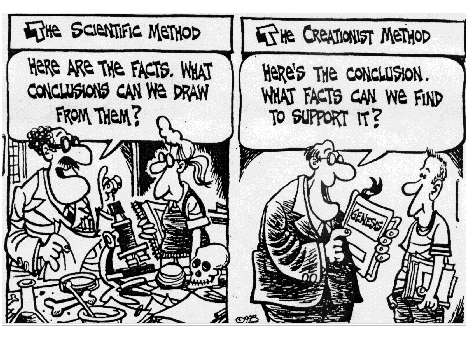
Sunday, May 9, 2010
Tuesday, May 4, 2010
Everything that Happened After Goliath
The changes that David goes through are amazing. Samuel's second book is so different from the first. David is always shown as a hero but this time he is seen as a crazy guy who lets power get to his head.
Monday, May 3, 2010
The Story About a Boy
To begin, I kept thinking that Samuel is very different than the other protagonists we've read about so far. He is the first to be telling someone else's story. Job told his and Genesis and Exodus did not have a specific author. I think that this is more reliable than the rest and it tells us a bit of his personality. As I see Samuel, he was a very obedient man who stayed very loyal to God and Israel - this isn't something new in the Bible, though.
I also think that God trusted Samuel and therefore, he secured information with him, such as knowledge of the new king. I've seen God trying to prove his followers' loyalty, never actually letting them know he trusted them.
I also think that God trusted Samuel and therefore, he secured information with him, such as knowledge of the new king. I've seen God trying to prove his followers' loyalty, never actually letting them know he trusted them.
Sunday, May 2, 2010
No more misery for Job
Where to begin? First of all, I thought that the beginning of Job's misfortunes were poorly justified and I found it hard to believe that someone like God, would be so influenced by someone like Satan. There were many things that surprised me in Job's story. First of all, Job's friends were very different from what I had expected them to be. I think that friends should encourage you to do right and be there for you during hardships. What Job lived through is not easy, and although his friends were there to "comfort" him, all they did was make things worse. The way that Zophar, Bildad and Eliphaz react to Job's punishments are far from what they should have said and done. The first thing that came to my attention was all the time they just sat next to Job, "So they sat down with him upon the ground seven days and seven nights, and none spake a word unto him: for they saw that his grief was very great." (Job 2:13) After thinking about it for some time, I thought that this was just useless. If the three of them were any bit concerned for Job's well being they should have gotten up and while Job mourned, they could have brought him new cattle or re-built his home. Instead, they claim that if Job had not done something of such magnitude, he wouldn't be receiving such a punishment. Also, his friends even claim that Job should receive even worse punishments and that what he was getting now was not enough to make up for what he had done. I thought about this and the only thing I came up with an idea that would justify this behavior coming from his friends: they were scared this might happen to them too so they decide to be on God's side. Now, they were not loyal to Job and they kept on insisting that God was being too nice with him. After I realized this, I understood them and although I do not agree with the way the acted towards Job, I do think that they did it only looking for their own redemption.
The first time I went over Job, I didn't understand his reactions or that of his friends. I was actually a little bored and I felt that Job was naive, and let all this happen to him without doing anything to stop it. Then, when we compared all the misfortunes that happened to Job with the events that took place in Elie Weisel's life, I began to look at it with different eyes. I couldn't understand why it was that Satan wanted to punish Job. Then, just as I realized with Job's friends, I saw that Satan just wanted to prove himself to God. Satan wanted to show his power and all the things he could do. Now, I would like to say that if Satan had any issues with God, he should have solved them with God directly and not with a human victim in the middle, especially one that is so "righteous."
When God finally says to Job that he will give him everything back, it sounded like an angry parent scolding his child and then spoiling him or feeling guilty for the punishment and then rewarding the child. Although it was a little different with Job, his issues with God were very serious. I thought that the arguments God used to "educate" Job on his power, were actually comical. I kept thinking of this problem I have with ignorance and I thought that if I were God, I would've had a similar speech only I would not have used it under the same circumstances. In that case, if I were God, I would've been more understanding and not so presumptuous with Job.
However, the end gave me the idea that Job lived happily with his new family after the tragedy, "42:16 After this lived Job an hundred and forty years, and saw his sons, and his sons’ sons, even four generations. 42:17 So Job died, being old and full of days." This ending is hopeful and I'm glad I changed my mind on Job in the end.
The first time I went over Job, I didn't understand his reactions or that of his friends. I was actually a little bored and I felt that Job was naive, and let all this happen to him without doing anything to stop it. Then, when we compared all the misfortunes that happened to Job with the events that took place in Elie Weisel's life, I began to look at it with different eyes. I couldn't understand why it was that Satan wanted to punish Job. Then, just as I realized with Job's friends, I saw that Satan just wanted to prove himself to God. Satan wanted to show his power and all the things he could do. Now, I would like to say that if Satan had any issues with God, he should have solved them with God directly and not with a human victim in the middle, especially one that is so "righteous."
When God finally says to Job that he will give him everything back, it sounded like an angry parent scolding his child and then spoiling him or feeling guilty for the punishment and then rewarding the child. Although it was a little different with Job, his issues with God were very serious. I thought that the arguments God used to "educate" Job on his power, were actually comical. I kept thinking of this problem I have with ignorance and I thought that if I were God, I would've had a similar speech only I would not have used it under the same circumstances. In that case, if I were God, I would've been more understanding and not so presumptuous with Job.
However, the end gave me the idea that Job lived happily with his new family after the tragedy, "42:16 After this lived Job an hundred and forty years, and saw his sons, and his sons’ sons, even four generations. 42:17 So Job died, being old and full of days." This ending is hopeful and I'm glad I changed my mind on Job in the end.
Subscribe to:
Posts (Atom)